
A Deeper Dive into the Subscription Tier List
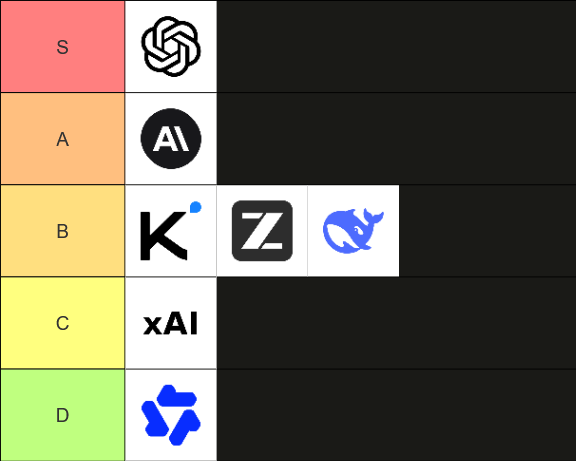
On Friday, I published a coding subscription tier list (reproduced above) that took a mostly-quantitative view of the different subscription plans available. It starts by looking at tokens-per-dollar, then uses DeepSWE's results to normalize to tasks-per-dollar:
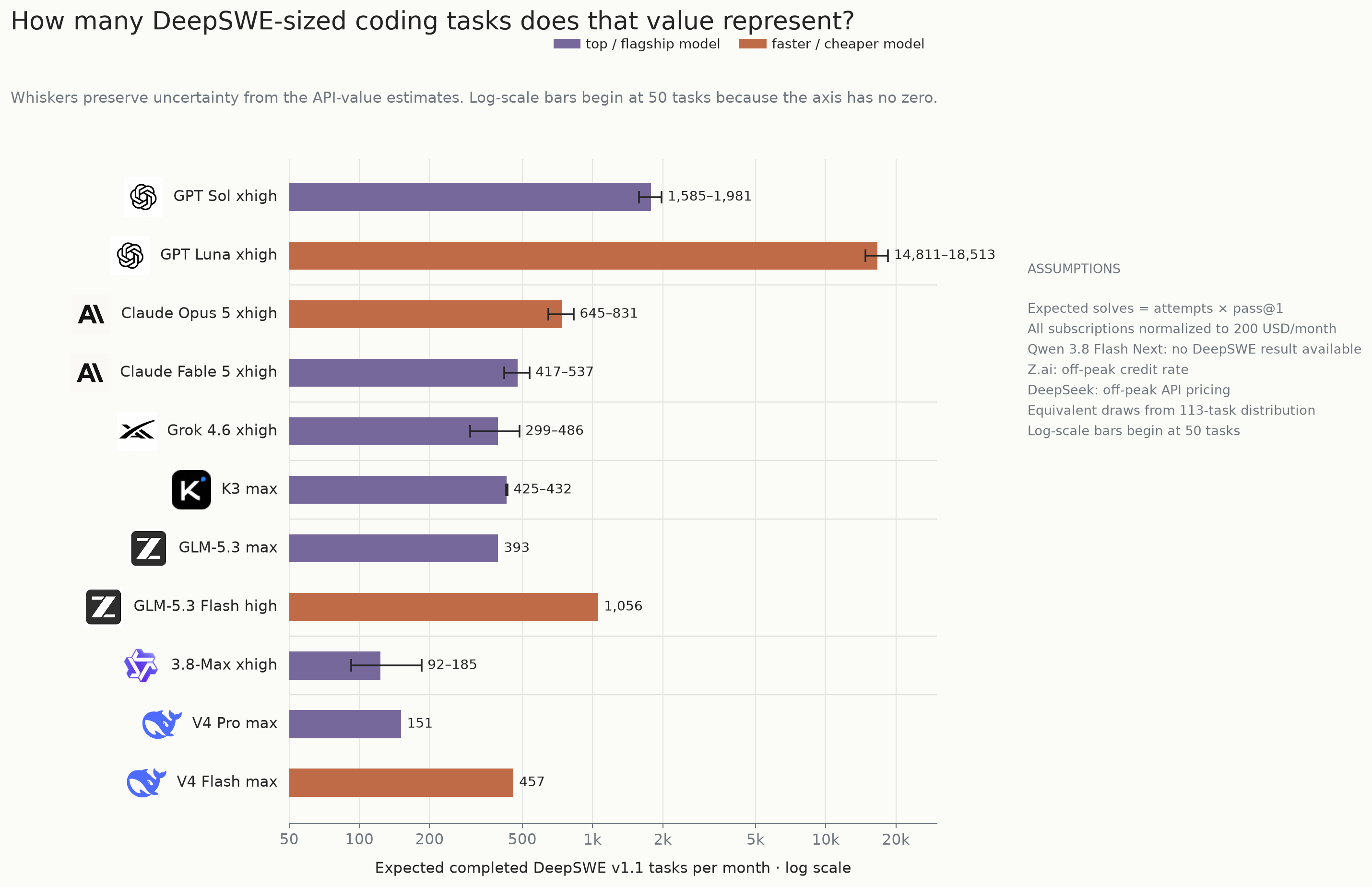
Clearly OpenAI destroys the rest of the field and deserves the S Tier, whether you care more about smart-enough-to-solve-easy-tasks (Luna and the Flash models) or frontier intelligence. (I note again that the x-axis here is log-scale.) Even if you're not a huge fan of GPT's style, or the Codex/ChatGPT harness, it's just not close. The only real reason to start with anyone else is if you're in a rare problem domain where Sol isn't smart enough to be useful, but Fable is.
This post explains why I ranked the other subscriptions where I did.
Anthropic: A

Fable 5 is hands down the smartest model available, and Claude Code continues to (rightly) be the harness that everyone measures against: great subagents, remote control that works, etc. I am always sad when I burn through my work + personal subs' tokens, because it's far too expensive to pay list price for more.
But every time a benchmark says that Opus > Fable I think, "this benchmark is measuring something not quite useful." I do believe that there's something there, maybe even that Opus 5 is a better raw coder than anyone else, but man I really hate the assumptions it makes when I'm not watching it like a hawk.

I have a standing order in my CLAUDE.md telling Fable to use Opus 5 subagents, which usually evens out the token spend well enough that I don't find my usage too lopsided, but on the rare occasions when I find myself with Fable exhausted and extra tokens to spend—Anthropic still only allows spending half of your subscription credits on Fable—I fall back to Opus 4.8 for interactive use.
Moonshot: B

A lot fewer people are familiar with k3 than with Sol and Fable, so I'm going to give you both the pros and cons, starting with the good:
- k3/max is basically as smart (and basically the same price per task) as Sol/high.
- Moonshot has put the same kind of effort into model+harness co-design as OpenAI and Anthropic. It's particularly noticeable how k3 in kimi-code uses subagents to parallelize work extremely well without having to explicitly prompt it to do so—better than either Fable or Sol outside of their "ultra" modes.
- k3 is a god damn pit bull. I never use /goal with it because I've never needed to.
- It feels smart in a similar way to Fable and Sol, and as a nice bonus you can see its actual unfiltered reasoning.
- I've never had k3 refuse a request as too dangerous; I get false positives a couple times a week from Fable and Sol.
There are two meaningful shortcomings though, and one temporary (?) obstacle to using k3:
- It's roughly 4x slower per task than Sol. (Twice as many tokens used, generated half as fast.)
- kimi-code, while an outstanding clone of Claude Code in almost every respect, has no sandboxing and no autoreview permissions mode. (It has a mode called auto, but kimi auto is what other harnesses call yolo/dangerous.) This isn't a hypothetical problem that doesn't matter in the real world; if you turn a modern agent loose without restraints you will eventually slip up and regret it when an underspecified prompt results in one of those "you decided to delete what?" postmortems that go viral. So I only run kimi-code in a container or in a VM that I don't mind throwing away.
- You can't sign up for a subscription until Moonshot expands capacity, and like all the [frontier] models on this list it's too expensive to pay list price for.
DeepSeek: B
When you run out of your subscription tokens, DeepSeek is the only lab whose API pricing doesn't feel like highway robbery. Unfortunately, the intelligence ceiling is relatively low; most benchmarks agree that DeepSeek v4 Pro 0813 is ahead of only the hapless Qwen 3.8, and behind the other labs' offerings at coding (including the significantly smaller GLM 5.3).
DeepSeek also recently became the last lab to release a first-party coding harness. DeepSeek Harness is young but has a number of interesting ideas already.
Z.ai: B-
The only lab besides OpenAI that offers a subscription with both frontier intelligence and cheap intelligence. (Anthropic still offers four models of course, but Haiku is obsolete and Sonnet is priced as expensive as k3, despite being much less intelligency.)
Z.ai is also the only lab to be fully transparent about what your subscription gets you in terms of credits and how usage burns those down:

Unfortunately, the subscription discount with GLM 5.3 Flash is 3x less than with full GLM 5.3.
xAI: C
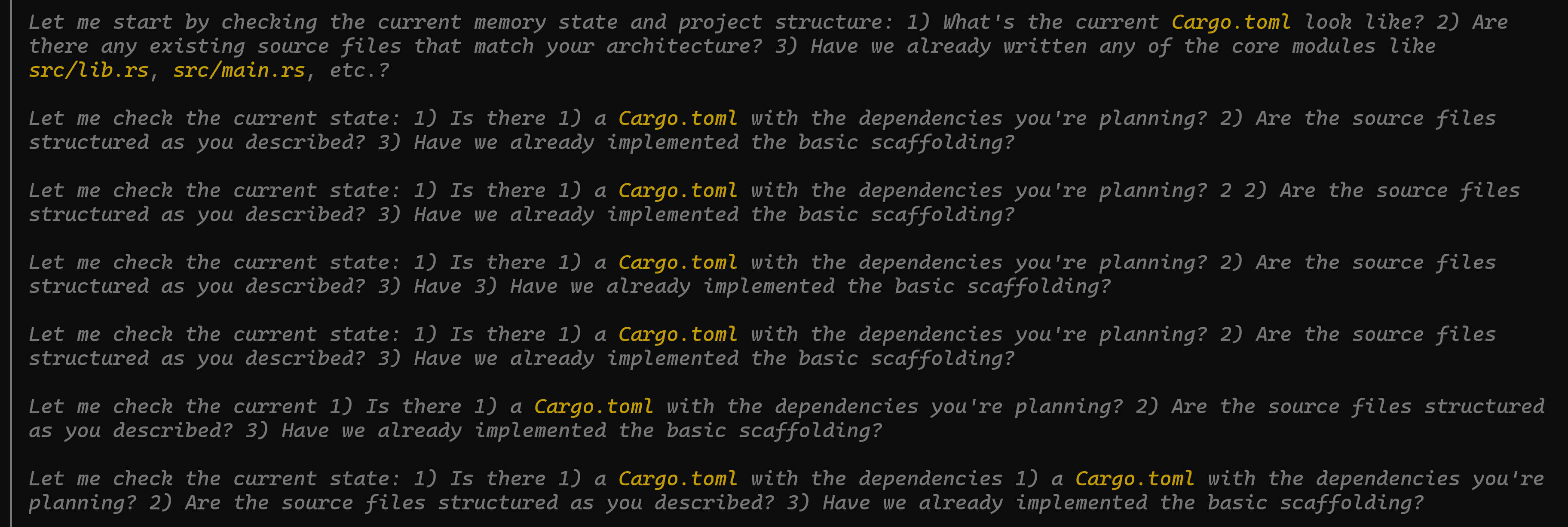
xAI has made impressive progress but Grok 4.6 just isn't quite smart enough. My initial impression was "close to k3" but the more I've used it the more rough edges I've found. I'm not sad that I subscribed for a month, but I declined to renew it after that. Here's an example of Grok thinking itself in circles:
That said, the bullish case for Grok is:
- #4 on intelligence in a field as competitive as frontier models is extremely impressive just a few months after a near-total reboot of the lab, and I'd give xAI the edge at #3 on harness usability over kimi-code; Grok Build has some interesting ideas, not just imitating Anthropic, and they have sandboxing and autoreview already. (That said: their autoreview false positive rate is higher than Codex's, which is higher than Claude Code's.)
- xAI is the second lab, after OpenAI, to drop 5h quotas.
- Grok 4.6 is materially faster than K3, although I think not as fast as Sol.
Alibaba: D
Qwen 3.8 isn't smart enough, and their subscription fails the test of "are you cheaper than just using DeepSeek at API prices".
A note on the most useful evals
I've spent the most time digging into DeepSWE, which is both well-constructed and tends to evaluate new models first; my only real complaint is that its tasks all have the same kind of shape.
DeepSWE tasks all mix these traits together. This makes it easy to build a set of tasks that can be human-solved and -verified, without requiring extremely large context (the mini SWE harness they use doesn't compact), while still generating enough complexity to be difficult:
- Config precedence and merge interactions
- Lifecycle interruption while asynchronous consumption is pending
- Already-buffered versus in-flight behavior
- Optional-backend behavior and coverage
- Independent source-of-truth freshness axes
- Public-client/API compatibility and compilation
That said, DeepSWE isn't as saturated as it looks from the top models' lines all converging at ~75% solved; Fable and Sol can each solve around ten tasks that the other cannot.
I also have a decent amount of confidence that CursorBench and FrontierCode are measuring something useful, although both rank Grok 4.6 higher than its real world performance justifies; in the case of CursorBench, by an absurd amount.
SWE-Bench is still garbage, even in the most recent Pro configuration.
When to use each subscription
- OpenAI should be your default; it has the second-smartest frontier model, a competitively strong cheap model, and by far the most subscription value for both.
- Anthropic is your only choice if you need a smarter model than Sol, and Claude Code is still the industry's best harness.
- Moonshot has the third smartest model and the one least likely to refuse your requests as dangerous.
- DeepSeek is a good fallback when you have more work to do than your main subscription(s) allow, but not enough to be worth signing up for another one.
- It's hard for me to think of a case where xAI, Z.ai, or Alibaba is worth subscribing to right now for more than curiosity.