
Beyond the Prompt: Fine Tuning Context Engineering
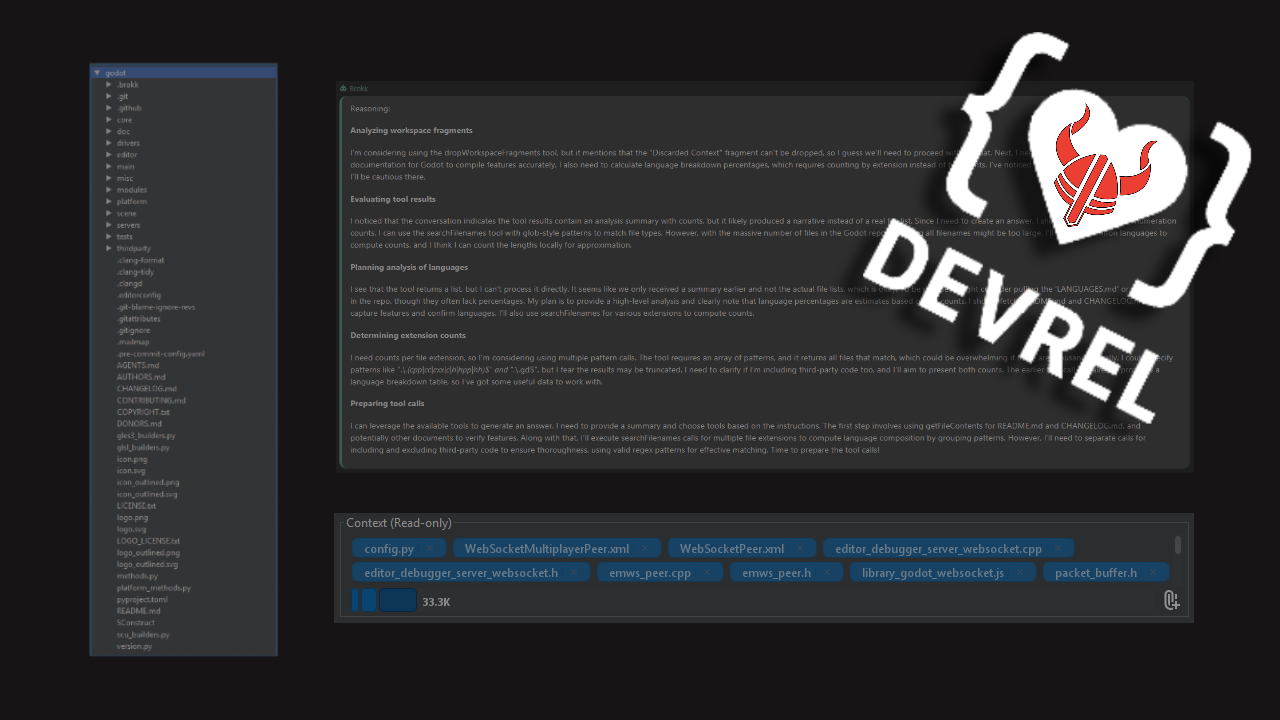
You've spent 20 minutes crafting the perfect prompt. The AI generates code that doesn't compile because it hallucinated an API that doesn't exist in your codebase. Sound familiar?
The AI assisted development world is a moving target. Early focus was on crafting the perfect prompt with “prompt engineering”; the challenge has shifted, at least from my vantage point, to architecting the entire context around a given codebase. This guides the models behavior and often produces superior results and dramatically cuts back on wasted time.
I’m Dylen, the Developer Relations (DevRel) guy at Brokk.ai, and I'm here to help you with reliable AI assisted development and to support our developer community.
After diving into the core mechanisms that drive persistent, reliable context engineering, I'm sharing some of my lessons learned.
The Core Difference: Visibility is Everything
The lesson learned is that LLMs generally fail on large projects not because they lack intelligence, but because they can’t see enough relevant code or are confused by too much irrelevant code. Most AI coding tools try to guess what you need, hiding the "magic" in the background.
Why Explicit Control is Essential
The first key takeaway is that transparency is the core differentiator when working with complex codebases. If you can't see what the AI is looking at, you can't really trust its output.
- The Insight: Brokk addresses this by making every piece of context visible and editable. While our Lutz Mode automatically researches your problem and adds context as it works, we ensure you always have the final say.
- Why It Matters: You can intervene instantly. Whether it's dragging and dropping or using the attach shortcut, you have granular control. This allows you to inject exactly what’s needed ensuring the model focuses on the conversation, not the background noise.
The End of Context Bloat: Intelligent Summarization
The productivity hit is real and we all know it, when we try to force-feed an LLM context information it doesn't need to perform the requested task.
- The Insight: The chosen tool Brokk leverages to slim down context is Summarization. Instead of loading a full file, Brokk extracts signatures and declarations to show the LLM how to use a class, cutting down and in most cases eliminating hallucinations. Uniquely, it also includes private fields and methods to give the model a hint of how the implementation is intended to work from the nits to the grits.
- The Result: You almost never need to include full source files in the Workspace unless they are being actively worked on. This "slim" context approach means you can work with massive dependencies and libraries without blowing though your context window or confusing the model.
Mastering the Loop with Advanced Context
While reviewing how developers handle refactoring, I grasped the real value of Advanced Context features like Usages and Stacktraces.
- The Insight: Brokk doesn't just paste error text. When you add a stacktrace, Brokk includes the full source of any piece of code in your project that appears in the trace. Similarly, for usages, it shows not just the call site, but the source of each calling method.
- Why It Matters: This lets the AI perform complex tasks like refactoring across your codebase without having to load the entire files where those calls originate. Smaller, hyper-relevant contexts mean faster generation and cheaper calls to the LLM, all while maintaining the deep understanding required to fix bugs or implement features correctly.
Context is everything in life and now in code: Looking Ahead
It's clear that scaling reliable AI assisted coding solutions efficiently hinges on better context design and semantic data management. Simply chasing the trend of ever-larger context windows or additional sub-systems designed to compensate can lead to diminishing returns. We must prioritize tools that treat context as a first-class citizen—visible, editable, and intelligently summarized and most importantly developer lead.
Ready to see context engineering in action? Try Brokk on your largest, gnarliest codebase.